Greenland is one of the least green places on earth, with around 80 percent of its surface covered by permanent ice. So why on earth is it called Greenland?
The name has puzzled travellers for centuries. Especially when you compare it to neighbouring Iceland, which is, in many ways, far greener. The answer lies in Viking history, medieval storytelling and a clever bit of early marketing. Here’s how Greenland got its name, what it’s called locally, and what people from Greenland are actually known as today.
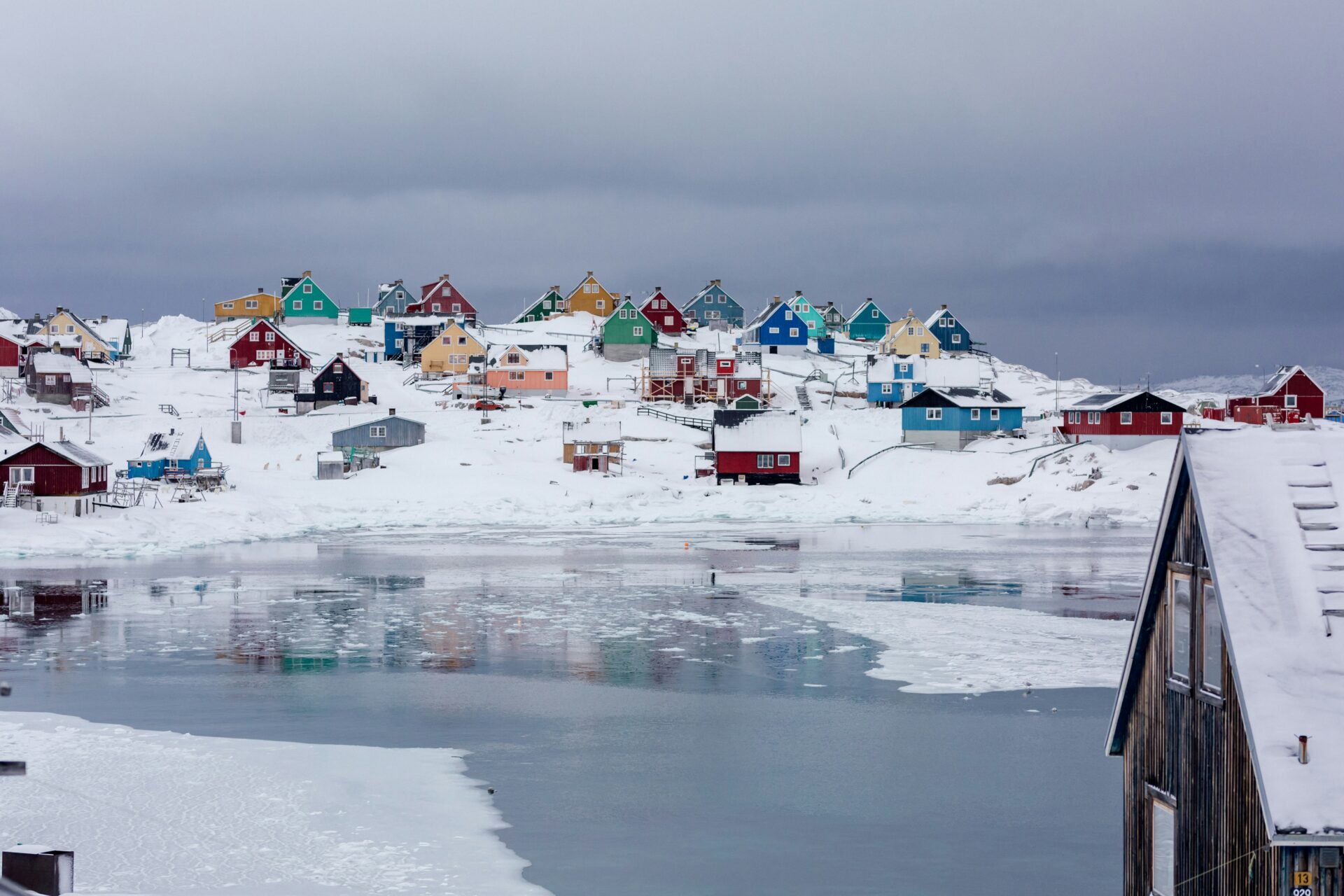
Recently, Greenland has attracted growing international attention. Not only because of climate change, but also due to geopolitical interest in the Arctic. As melting sea ice opens new shipping routes and access to natural resources, the island has become strategically significant. Despite this global focus, Greenland remains a self-governing territory within the Kingdom of Denmark, with a strong Indigenous Kalaallit identity.
Read on to find out all about the Norse etymology of Greenland, who gave Greenland its name, and to discover what are Greenland natives called.
Why did they call Greenland Greenland?
Legend has it that Greenland was named by the Viking Erik the Red. He landed in Greenland in around 983 AD with a small group of settlers.
Erik travelled around Greenland, naming several parts of the island after himself as a way of claiming ownership, including Eriksfjord (now renamed Tunulliarfik Fjord), where he settled and built his home.
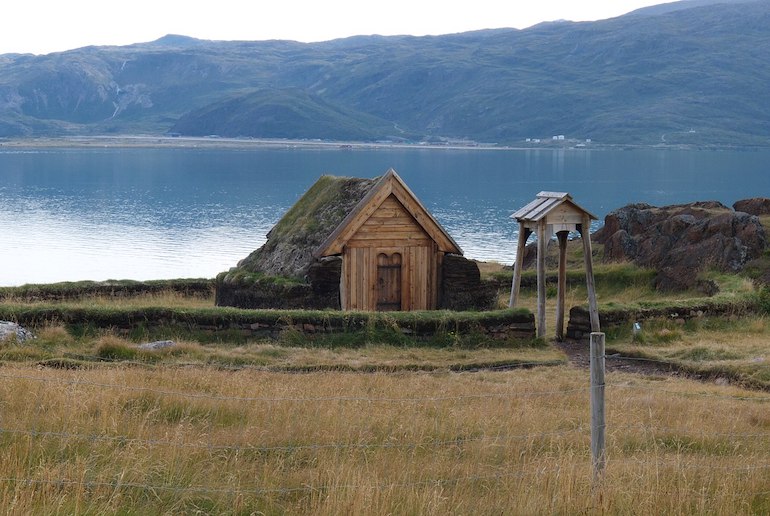
The homestead that he built, called Brattahlíð, lies at the top of a sheltered fjord in southwest Greenland. Here, the current settlement of Qassiarsuk is now located. It’s protected as a World Heritage site and the former church here, thought to have been built in the fourteenth century, has been reconstructed.
Once Erik had established settlements in some of the more fertile, greener parts of the island, he sailed back to Iceland to try and persuade some of his fellow kinsmen to join him in Greenland. The prevailing theory is that he told them the new land he had discovered was called Greenland, because he thought it would make it sound more appealing to potential settlers!
His PR ploy must have worked because he left Iceland with 35 ships full of Icelanders and animals to colonise Greenland. However, only 14 of the ships actually arrived.
Who was Erik the Red?
There are many legends and stories associated with Erik the Red, who features in the Icelandic sagas. Some sources say that he was a Norwegian explorer. Others others claim that he fled from Norway with his father who was exiled for murder.

Either way, Erik and his father left Norway and sailed to Iceland. There, they settled and Erik married a local woman called Thorhild from a wealthy family. However, Erik was soon exiled from Iceland too, after being convicted of the murder of two of his neighbour’s sons.
Since he couldn’t return to Norway, he sailed further west still and landed in Greenland. Accounts of Erik the Red describe him as having bright red hair and a beard, hence his name. Other sources, however, suggest he got his name because of his fiery temper – a fact possibly borne out by his convictions for murder!
Why is Greenland called Greenland and Iceland called Iceland?
So, we can see that Greenland’s name came about from an attempt to lure settlers to come and colonise it.
It’s also likely that Greenland was actually greener a thousand years ago when Erik the Red landed there. Some archaeological evidence suggests that parts of southern Greenland supported shrubs and limited woodland during warmer periods.

And it’s true that Erik landed in one of the most sheltered and temperate parts of the island – which is actually further south than Iceland – so perhaps he didn’t realise quite how icy the rest of the island was!
But how did Iceland get its name, when only around 11 percent of the country is covered in permanent ice caps?
It seems that the island’s original name was actually Snæland (which means Snowland). But, it was renamed by a Viking called Hrafna-Flóki, who saw a fjord full of ice-bergs and so called the island Iceland. Hrafna-Flóki is thought to have had a hard time in Iceland. His daughter drowned on the way there and all his animals died during his first winter there. Therefore, he may well not have felt too positive about the island, and wanted to dissuade other settlers from coming there – hence the slightly less appealing name.
And whilst it may seem that the two countries’ names are the wrong the way round, they may actually become more fitting in the future.
Scientists have long warned that climate change is causing Greenland’s ice sheet to melt at an accelerating rate. While some ice-free areas may expand, the overall impact is complex and deeply concerning, with significant consequences for global sea levels rather than simply making the island “greener”.

Some climate models suggest that large-scale ice melt in Greenland could influence ocean currents in the North Atlantic. Scientists are still studying how these changes might affect neighbouring countries such as Iceland.
What does Greenland mean?
Greenland is the anglicised version of the island’s name – it’s Grœnland in Old Norse, Grænland in modern Icelandic and Grønland in Danish and Norwegian. In Greenlandic, the island is called Kalaallit Nunaat, meaning “Land of the Kalaallit”. This reflects the identity of the Indigenous people who have lived on the island for centuries.

Another name for Greenland is Inuit Nunaat, which means “land of the people”.
How do you call someone from Greenland?
Inhabitants of Greenland are called Greenlanders (or Grønlændere in Danish), or Kalaallit, which means “indigenous Greenlander” in the native language Kalaallisut. Around 90 percent of native Greenlanders are of Inuit descent, and so refer to themselves as Kalaallit.
The Kalaallit are actually a tribe of Inuit who come from western Greenland, and there are also smaller tribes – the Tunumi-it from eastern Greenland and the Inughuit from the north of the island. However, since the Kalaallit are by far the majority tribe, it is this name that has been adopted for general use. So, citizens of Greenland are called both Kalaallit and Greenlanders.
From Viking marketing to modern Greenland
So, why is Greenland called Greenland? The answer lies in Viking ambition, medieval storytelling and centuries of historical continuity. Whatever the original intention behind the name, it has endured. Even as Greenland’s role in the modern world continues to evolve.
Were you surprised by the story behind the name? Or do you know another Nordic place name with an unexpected origin? Let us know in the comments below.
See also:
Greenland vs Iceland
Do people live in Greenland?
Seeing the northern lights in Greenland